
- Tuesday 04 November 2025
You’ve probably seen the headlines splashed across financial news sites:
“The S&P 500 is up strongly year-to-date.”
That sounds great, doesn’t it? Yet when you check your own portfolio, the excitement often fades. If you hold something like the Vanguard S&P 500 ETF (VUSA.AS), your gain may look far smaller-around 2.4% year-to-date.
So what’s really happening here? Why doesn’t your return line up with the index performance you keep hearing about? The short answer: it’s not the stocks , it’s the currency.
The Currency Connection Most Investors Miss
The VUSA.AS ETF is euro-denominated and unhedged, even though it invests in U.S. stocks. That detail matters a lot. Your actual return depends on two moving parts:
1️⃣ The performance of the S&P 500 in U.S. dollars, and
2️⃣ The exchange rate between the euro and the dollar.
When you invest internationally, you’re effectively taking part in two markets - the equity market and the currency market. Even if the stocks perform well, a shift in exchange rates can dramatically alter your local-currency result.
How the Euro Changed the Story in 2025
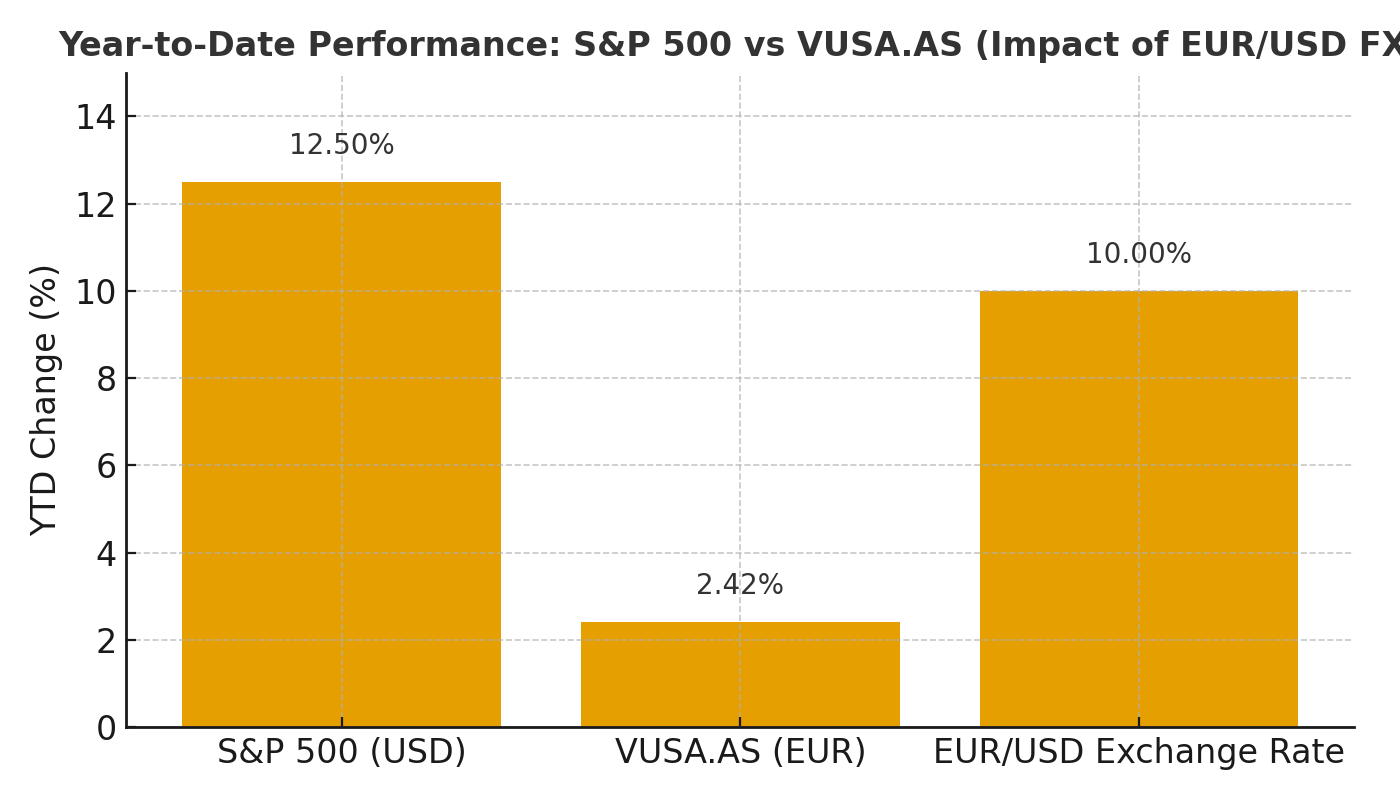
This year offers a perfect example. While the S&P 500 has climbed roughly 12.5% in USD, the euro has strengthened by nearly 10% against the dollar. When you translate that performance back into euros, the stronger currency wipes away much of the stock market’s gain.
As a result, your euro-based return shrinks to about 2.4%. The math can feel frustrating, but it highlights a key reality of global investing: your returns don’t just depend on the index - they also reflect currency movements.
♦ If you visualize it, a chart comparing the S&P 500 in USD, the VUSA.AS in EUR, and the EUR/USD exchange rate tells the full story.
What This Means for Long-Term Investors
Now, this doesn’t mean you should avoid global markets or rush to hedge every currency exposure. On the contrary, currency movements often balance out over time. One year the exchange rate might hurt your returns, but the next it could boost them.
Therefore, the key takeaway is to stay focused on long-term, diversified growth. Currencies rise and fall, but well-diversified portfolios tend to smooth out those temporary fluctuations. Instead of reacting to short-term noise, maintain your investment discipline and remember what you’re truly investing for - future growth, not quarterly headlines.
Final Thought
In global investing, it’s easy to get caught up in headline numbers. But understanding the role of currency can help you interpret your results with clarity and confidence. So next time you see the S&P 500 soaring, take a moment to check how your home currency is moving too, because that’s the missing piece most investors overlook.